Showing posts with label chicken. Show all posts

Monday, 22 June 2015

Cheater's Chicken and Sausage Jambalaya

I may have mentioned before, but I love cooking traditional foods from many cultures. And the reason why I like cooking these foods is because I know that every village, every family, every region had their own variations. Despite what we may think today what with standardised cookery books, there was no hard and fast "rules" about what had to go into that dish, or what proportions were needed.

I love foods I can cook without having to follow rules. I especially like dishes that I can cook up without a lot of fuss, while using up leftovers at the same time.

One dish that works very well here is a Jambalaya. This traditional Cajun food dish was made using core ingredients of onion, bell pepper, and celery plus rice and Cajun spices, and then whatever meat was available after a day's hunting and fishing - rabbit, chicken, fish, seafood, alligator - you get the idea.

Traditional recipes today tend to have chicken, andouille sausage, and prawns. But they can be made using any meat, or none at all. Likewise, you can add any vegetables you want - corn, peas, beans, or anything else.

I had some leftover sausages and chicken from our dinner the other night I wanted to use up, so I decided to turn them into a tasty jambalaya. This quick and easy recipe can be cooked and on the table in under 45 minutes.

Chicken and sausage jambalaya


Serves: 3

Cooking time: 30 minutes


Ingredients:

  • 1 medium onion, chopped
  • 2 stalks celery, chopped
  • 1 bell pepper (any colour), seeded and chopped
  • 1 cup uncooked wholegrain basmati rice
  • 1 tin chopped tomatoes
  • 2 tsp Cajun spice mix
  • 2 cups water 
  • 2 cooked chicken breasts, cut into bite-size pieces
  • 4 cooked Cumberland sausages, cut into bite-size pieces
  • salt and pepper to taste

Method:
  1. Sweat off the onions, pepper, and celery with a bit of the water in a large pan until softened. 
  2. Add in the rice and Cajun spice mix and stir until coated.
  3. Pour in the water, bring up to a boil. Reduce heat and let simmer, covered, about 25 minutes. 
  4. After 10 minutes, add the cooked chicken and sausage and continue simmering. 
  5. Taste and season with salt and pepper as desired.
  6. If necessary, remove the lid and boil off any excess liquid before serving. 

Wednesday, 19 November 2014

Stuffed Chicken Thighs with Gravy


I like stuffing chicken thighs (or breasts) to add to the flavour, and give a bit of variation to every day meals. I don't always like the hassle of making the stuffing though so will often substitute a ready-made one. I cooked these stuffed chicken breasts for our dinner the other night and my youngest son loved them.

Stuffed chicken thighs with gravy

This recipe serves 4
Bacon wrapped chicken thigh with sage and onion stuffing


You will need:

4 chicken thighs, with bone removed
1 pack sage and onion stuffing
8 slices bacon
Black pepper
Olive oil


Method:

  1. Prepare the sage and onion stuffing per the directions on the box. The type I use you just pour the contents into a bowl and add about 200ml cold water, give it a stir then let it sit for 5 minutes.
  2. Place two slices bacon on the cutting board, lay the thigh flat on top. Place a spoonful of stuffing into the middle and roll up the thigh around it with the bacon.
  3. Drizzle a bit of olive oil into the bottom of a baking tray and place the wrapped thigh on top. Drizzle a bit more olive oil over the top if desired and sprinkle with a bit of black pepper.
  4. Bake in a moderately hot oven for about 30 minutes, until the chicken is cooked through completely.
  5. The gravy can be made relatively easy.
  6. Melt a small amount of butter in a saucepan. Add a spoonful of flour and cook, stirring constantly for 2 – 3 minutes. Pour in 1 pint chicken or vegetable stock, a bit at a time, until the desired consistency is reached. Season with pepper. I find that most store-bought stocks are salty enough so don't add any more salt unless you taste the gravy and think it's needed. To lift the flavour just a tiny bit more, try adding a ½ teaspoon of malt vinegar.
  7. Serve these stuffed chicken thighs and gravy with a seasonal green vegetable and mashed potatoes.


If you'd prefer to use chicken breast…

This dish can be made equally well using chicken breasts. I just prefer the flavour of the thighs, plus they're cheaper.
You can either butterfly open the breast, or cut a pocket into the centre before stuffing the breast and wrapping it in the bacon. 

How to

Debone a chicken thigh:

Place the thigh skin side down on a cutting board. Using a sharp knife make a cut on either side of the
Slide the knife under the bone
bone, slide the knife underneath the bone on one side and run it down the underside. Then detach it at the top and bottom.

Butterfly a chicken breast:

Place the breast skin side down on the cutting board facing lengthwise away from you. Using a small sharp filleting knife, cut 2/3 straight down the middle, perpendicular to the board. Turn the knife at a right angle and now cut parallel with the board 2/3 of the way through one side, and then the other. Fold open the breast to either side. If the breast is especially thick, you may want to make another parallel cut to fold it out a second time.
You can then place a spoonful of the stuffing into the centre and wrap the breast around it.

Open a pocket in the breast:

Place the breast on the cutting board with the thicker side closest to you. Using a sharp filleting knife make a cut through the centre of this thickest part at the side, cutting parallel to the board and using your non-dominant hand to hold the breast steady on the board. Move the blade back and forth to enlarge the pocket while taking care not to cut through the other sides or through the bottom.
Using a spoon or (as I do) your fingers, push a small amount of the stuffing into the pocket.


Why bacon?

I will either wrap the breast in streaky bacon or will use the reserved skin from off the breast to wrap the chicken once stuffed. This helps to keep the meat moist while adding flavour as well as keeping the whole thing from coming apart while cooking. Feel free to omit and use cocktail sticks, or use a lower-fat bacon if you desire.

Monday, 6 January 2014

Put a Little Spice Into Your Life

Chinese Five Spice, Pumpkin Spice, Mixed Spice, Curry Powders. They add variety and flavour to your food dishes, whatever the cuisine.

These assorted spice mixes can also be quite costly at the shop so the temptation to buy in bulk when they're on sale might be high.


Don't do it!


Long before you can use that jar up, the spice mixture will have gone stale and lost its flavour.

Instead, buy smaller amounts of the individual spices and make your own spice mixes at home. You'll save money, and benefit from the enhanced flavours.

My spice gear

Mortar and pestle with spice book

A good reference book, and an even better grinder are what I have to hand. A small coffee grinder works perfectly for grinding harder spices. I have a separate one for grinding coffee beans. 

When I want to do things by hand, I have good, heavy duty mortar and pestle. I use it for grinding small mixtures as I need them. Right now, it gets its most use when I am making a bolognese sauce as I use it to grind the fennel seeds and dried herbs.

Chinese Five-Spice Powder

Different recipes will have different spices in a 5-spice mix. This is the one I've found that I like best. 
  • 3 Tablespoons ground cinnamon
  • 6 star anise (or 2 teaspoons aniseed)
  • 1 1/2 teaspoons fennel seeds
  • 1 1/2 teaspoons whole Szechuan peppers, or whole black peppers
  • 3/4 teaspoon ground cloves 
Place ingredients in a food processor or a coffee grinder. Cover and process to a fine powder.

Store it in a tightly covered container in a cool, dark place.

This makes 1/3 cup.

Recipe using five-spice powder

Several years back, I was eating lunch at a small pub in West Sussex. I had a duck in plum sauce that was absolutely delicious and on a whim I asked the landlady if the chef would be willing to give me the recipe for the plum sauce. He did, sending the recipe out on a small sticky note. I made it. The recipe filled one pint jar and lasted for several months in the fridge.
Plum sauce

Plum Sauce

  • 1 kg plums
  • 400 grams sugar
  • 2 teaspoons Five-spice powder
  • Small amount of water

Wash and quarter the plums, removing the stones. Combine with the other ingredients in a large saucepan. Simmer over a low heat until it starts to gel. Keep in a clean covered jar in the fridge.

This condiment goes very well served with duck, chicken, and pork. I like it served alongside cooked sausages as well.

Cajun Spice Mix

 I use this mix for making jambalaya, but have also found that it is good mixed with olive oil as a marinade for chicken.

  • 1 Tablespoon salt
  • 2 teaspoons garlic powder
  • 2 teaspoons ground black pepper
  • 1 1/2 teaspoons ground cumin
  • 1/2 - 1 teaspoon cayenne pepper (adjust to taste)
  • 1 1/2 teaspoon paprika
  • 1 1/2 teaspoon barbecue seasoning powder 
Mix these ingredients together thoroughly. Store them in a tightly covered container in a cool, dark place.

Recipe using Cajun spice

Cajun Chicken Strips with swede chips

Swede (rutabaga) makes good chips
This is a quick, easy, and healthy meal.

Chicken strips

For 2 adults and 2 children, you'll need 3 large chicken fillets.

Cut the chicken fillets into strips, about 1/2 inch thick and 3 inches long.

Put those into a bowl with 1 - 2 heaped teaspoons of cajun spice mix plus about 1 Tablespoon olive oil. Mix it all around so the chicken is completely coated.

Let it sit for 10 - 20 minutes.

Heat a large skillet. Add half the chicken strips. Cook through. Remove from the pan and cook the remaining chicken. Keep warm until ready to serve.

Swede chips

The swede is also called a rutabaga.

Peel the swede and cut it into wedges, 1/2 inch wide by 1/4 inch thick by 2 inch long.

Put into a steamer, and steam for 10 minutes.

Remove from the steamer and dry thoroughly.

Heat 1/4 inch olive oil in a skillet.

Lay the swede in the skillet in a single layer. Cook until 1 side is lightly browned then turn over and cook the other side.

Remove from the skillet and place on kitchen paper to drain.

Keep warm until ready to serve.


For a dipping sauce, mix 2 tablespoons mayonnaise with 1 tablespoon tomato paste. Add a few dashes of tabasco sauce to taste. Season to taste with salt and pepper. 

Or, mix a teaspoon chipotle in adobo sauce with a cup of mayonnaise for a smoky, spicy flavour.
 

Curry Powder

Curry powder spices roasting
The word curry is a corruption of the Tamil word kahri. This word evolved over time to mean any Indian food that was cooked in a sauce. Merchants and soldiers who visited India were keen to introduce these flavours to their foods when they returned home and the demand for commercial curry powders developed.

Curry powder is a blend of different spices and will vary depending on the region it comes from. It is not a traditional, authentic ingredient in Indian cooking.

The basic recipe below can be adapted and adjusted to suit your personal taste and the main ingredients for any particular dish. It makes 16 tablespoons. Store any unused in a covered jar in a cool, dark place.


  • 6 - 8 dried red chillies
  • 8 Tablespoons coriander seeds
  • 4 Tablespoons cumin seeds
  • 2 teaspoons fenugreek seeds
  • 2 teaspoons black mustard seeds
  • 2 teaspoons black peppercorns
  • 1 tabespoon ground turmeric
  • 1 teaspoon ground ginger 
1. Remove the stalks and seeds from the chillies unless you like a fiery mixture, in which case leave a few seeds in the pods.

2. Roast or dry-fry the chillies, coriander, cumin, fenugreek, mustard seeds, and black peppercorns in a heavy-based pan over a medium heat until they give off a rich aroma. Shake the pan constantly so that the spices are evenly roasted and don't burn.

3. Grind the roasted spices to a powder in a mortar and pestle or a coffee grinder, then stir in the ginger and turmeric.

Variations

Dry-fry 4 curry leaves and add them to the ground mixture; remove from the cooked dish before it is served as the curry leaves are not eaten.

For a milder result, halve the number of chillies, then add 1 cinnamon stick, 1 Tablespoon fennel seeds, and 6 whole cloves to the spice

Recipe using curry powder

Pork Curry
Pork curry

1 large onion, sliced
2 Tablespoons olive oil
1 pound cooked pork, cut into cubes
1 Tablespoon flour
1 - 2 heaped Tablespoons curry powder
1/2 pint chicken broth
1 tin chopped tomatoes
1 tin diced pineapple, drained
1 Tablespoon tomato paste
salt and pepper to taste
cooked rice

Saute the onion in olive oil until softened. Add the cubed pork.

Add the flour and curry powder. Stir and cook for a couple minutes.

Add the chicken broth. The tin of tomatoes, tin of pineapple, and tomato paste.

Season to taste. Let cook at a low simmer for 15 - 20 minutes, until it's thickened.

Serve over rice.

Mixed Spice

Mixed spice
This is a typically British spice that can be bought ready ground. It can be used in a variety of cakes and puddings as well as in cooked breakfast porridge or muesli. The usual components are allspice, cinnamon, cloves, nutmeg, and ginger but some cooks like to add some cardamon and coriander seeds as well.

This recipe makes 2 Tablespoons.
  • 1 teaspoon allspice berries
  • 1 inch cinnamon stick
  • 1 teaspoon whole cloves
  • 1 teaspoon ground nutmeg
  • 1 teaspoon ground ginger 
 Grind the allspice, cinnamon and cloves to a fine powder and mix well with the nutmeg and ginger. Use at once or store in an airtight jar away from strong light.


Recipe using mixed spice

Porridge

Porridge
Mixed spice is best known for its use in puddings and cakes, but in our house it is most used when making that most basic of breakfast foods, porridge.

For one person:

Put in a small saucepan:

  • 150 ml milk
  • 1/2 teaspoon mixed spice
  • 1 teaspoon brown sugar
  • 1 very small handful sultanas
  • 1/2 apple, diced

Heat in a small pan until near boiling.

Add
  • 2 heaped tablespoons porridge oats

Stir until oats are fully cooked. 4 - 5 minutes.

If you like your porridge thicker as I do, just add a bit more oats.


Wednesday, 1 January 2014

Savoury Meat Pies

Shepherd's Pie
The British savoury pie is a time honoured tradition. This is simple food at its most delicious. A steaming hot filling of gravy, vegetables, and meat surrounded by a pastry shell or topped by a thick layer of mashed potatoes. Served up on a plate with a large spoonful of fresh seasonal vegetables, it's meal fit for any table.

These pies can be the perfect way to use up cooked bits of meat and cooked vegetables from a family roast dinner. They're also good when you want to stretch a few ingredients out to feed the family. Favourites at our house include beef cottage pie, beef pie with a puff pastry topping, chicken pie, and shepherd's pie.

Cottage Pie or Shepherd's Pie

I sometimes see some confusion between these two similar pies, but it's realy very simple. A shepherd's pie is made using lamb or mutton, and a cottage pie is made using other meats like beef or chicken.

Otherwise, they're made exactly the same way.

You will need: 

Leftover roasting joint (beef, lamb, or chicken) - pull as much meat as you can off the bones then put the bone into a pot of water to make a stock.
1 large or 2 medium onions, roughly chopped
1 - 2 carrots, diced and cooked until soft in boiling water
1 cup frozen peas or corn
Herbs and spices - pick 2 or 3 that go with whatever meat you're using. For instance, rosemary goes well with lamb or beef, sage and thyme go well with chicken
Salt and pepper for seasoning
Gravy
Mashed potatoes

Chop meat in food processor
1. Roughly cut up the leftover meat and then put it into a food processor and pulse it a few times until you get the desired consistency. I prefer to have a few bigger pieces but other may way it to be completely chopped into small pieces. If you don't think you'll have enough meat, add in a couple slices of bread and chop those in as well. 
Cook onions and frozen vegetables

2. Heat about a tablespoon olive oil in a pan (I use the wok because it's big enough to do all the mixing as well) and cook the onions until the are soft. Add in the frozen peas or corn and whatever herbs or spices you might want to use. Continue stirring occasionally and cook down until you just start to see some browning on the sides of a few of the veggies. Season to taste with salt and pepper. Now remove it from the heat.

3. Add in the cooked carrots and the chopped meat and mix together.
Pour over  gravy to make a wet mix

4. Use the stock to make a gravy for the pie. Pour enough of the gravy over the meat and vegetables to make a rather wet mixture. Spoon this into your casserole dish. It should be big enough to hold all of the mixture and leave a half inch minimum from the top of the dish.
Spoon mix into casserole dish

5. Mash your cooked potatoes and spoon that over the top of the mixture.

You'll need enough potatoes mashed to cover the entire top of the casserole dish to a layer of at least 1/2 inch. I generally use 5 - 6 large potatoes for a 2-quart dish. You'll want to make a dry mash, so don't add any milk and just a small amount of butter when mashing as the mash will absorb some of the moisture from the meat mixture while cooking.
Spoon mash over the top

6. Spread the mash to cover the entire mix and seal it around the edges. Using a fork run across the top to rough up the surface then dot with a bit of butter and season with salt and pepper. This will give you crunchy bits on top.

Rough up the surface with a fork

7. Place on a baking tray to catch spills and bake in a moderately hot oven (Gas Mark 6/400f/200c) for 35 - 45 minutes, until the topping is browned and the filling is hot and bubbling.

8. Serve it hot. I like to make extra gravy to pour over the top of mine

Cooked shepherd's pie ready to eat


Friday, 20 December 2013

Baked Chicken and Sausages

Ever have one of those nights when you know you need to cook something for the masses, but it's the tail end of a week and you've not been shopping, or you just don't want to spend a lot of time standing in the kitchen?

Well, that's the night I've had tonight.

I had a chicken and a couple packs sausages in the fridge that both really wanted using tonight, and I didn't feel like spending lots of time in the kitchen, so tonight we are having baked chicken and sausages. It's like a roast chicken, except I cut the chicken up so that it would cook quicker. This isn't a quick 30 minute meal, but it is certainly easy.

Baked chicken with sausages

I drizzled olive oil over the top then sprinkled over dried sage and thyme, salt and pepper. This then went into the oven at Gas Mark 6/400F/200C. I've set the timer for 25 minute, and will flip the sausages around to brown the underside then place it all back into the oven to cook another 20 minutes.

This will be served with broccoli and mashed potatoes.

There's a good chance I will have leftovers tonight, so I'll use those to make either a soup or a pile of mini chicken pasties tomorrow night.

Chicken pasty

Thursday, 12 December 2013

Two for One Chicken Dinners: Making the Most of Your Chicken

These days I only ever buy free range and/or organic chickens, so to make the most from the money spent I always try to get at least 2 meals from every chicken. Plus I will combine the back and rib sections from several chickens to make chicken stock for soups or risotto.

These simple measures help to stretch the food budget just that little bit further. I have shared some of my favourite chicken recipes here to help you stretch your food budget that little bit further.

*These recipes will all work equally well with leftover turkey.*

 Chicken Dinner 1 - The Roast

Roast chicken with stuffing and chipolata sausages

Picking out a good chicken to start with is paramount. The breasts and thighs should be plump with large pads of fat. A 2.5 - 3 kg chicken is generally a good size to feed a family of four plus give some leftovers for the rest of the week.

Check out my tips for cooking the perfect roast dinner.

Preparing a chicken for roasting

The "experts" can't agree on whether it is better to rinse the chicken or not. I prefer to rinse the inside and make sure the cavity has been cleared. Then it can be patted dry inside and out with a few sheets of kitchen paper.

Tuck the wings behind the back. Check the inside of the chicken and pull out any pads of fat that may be present. These are useful for basting the chicken during cooking.

Place the chicken in a roasting tin and place reserved fat from previous roasts around the outside and on top of the chicken. Place the reserved pads of fat on top of the chicken as well. Lard or butter will work if you have no reserved fat.

Stuff the cavity with your favourite stuffing, if you wish. Otherwise, put a small onion cut in half, a few sprigs fresh thyme, a small handful of fresh parsley, and a sprig of fresh rosemary inside the cavity.

Cover the roasting tin with a length of foil, pleated to allow for expansion. Put it into a preheated oven on the middle rack.

Oven temperature: Gas mark 6/ 400F/200C/moderately hot.

The chicken needs to cook for 25 minutes per pound, plus 25 minutes. Be sure to include the added weight of the stuffing.

Uncover the chicken and baste it when it has 1 hour cooking time remaining. Leave it uncovered so that it can brown.


Invest in a Good Roasting Pan

We've all seen the flimsy disposable roasting trays you can get in the supermarkets around the holidays. They're pretty worthless and unless you only intend to cook a roast once a year, completely uneconomical. Invest in a roasting pan which you can use over and over again. I strongly recommend against purchasing a pan which has any non-stick coating. The heat from the cooking fat will peel that right off and you will end up with the flakes on your food. Yuch!


Master Class Roasting Pan, Vitreous Enamel, 40cm x 28cm x 7.5cm

Finishing off the Roast

Once you have roasted your chicken, drain off all of the fat and any liquid from the roasting tin into a glass container. I use a pyrex bowl. When cool, that can be kept in the refrigerator, covered or uncovered.

After your meal, pull off as much remaining meat as you can from the chicken. Save that in a covered bowl for 2 - 3 days in the fridge.

Use the carcass and any reserved jelly and fat to make a chicken stock.


Chicken Dinner 2: Leftover Chicken

Chicken Enchiladas


Chicken Enchiladas, Wikimedia Image in Public Domain
Dice the cooked chicken and place into a bowl.
Chop 1 onion
Seed and chop 1 green pepper
Seed and chop 1 red chili
Melt 2 tablespoons butter in a saucepan. Add the chopped vegetables and cook until soft.
Add 1 teaspoon ground cumin
Add 1 teapoon ground turmeric
Add 1/4 teaspoon, more or less to taste, dried chilli
Add 1 heaped tablespoon plain flour.
Stir constantly for 1 - 2 minutes over a low heat.
Gradually add enough milk to make a medium white sauce. (No, it won't be white)
Add salt and pepper to taste.

Once the sauce is made you can either -

Roll the chicken up in tortillas with a bit of sauce and a small amount of cheddar cheese.
Place them in a casserole or deep baking dish, cover over with any remaining sauce, more cheese, and a few chopped chillies.

OR

Make what I like to call a chicken enchilada lasagne.

Butter the bottom of a casserole dish. Put a layer of tortillas, a large handful of chopped chicken, a layer of sauce, and a bit of cheese. Repeat the layers, finishing with the cheese. Add a few green chillies to the top if you want.

Both will bake in the oven for approximately 20 minutes in a moderately-hot oven. Gas mark 5/375F. The sauce and cheese should be browned and bubbling on top.

Chicken Pie

 
Chicken pie with puff pastry

Make the filling

Dice 1 cup cooked chicken
Chop 1 onion
Peel and dice 1 large carrot
Mince 1 clove garlic
1 cup frozen peas

Saute the onion, carrot, garlic, and peas until the onions and carrots are softened.

Add the diced chicken.

Add 1 teaspoon fresh or 1/2 teaspoon dried thyme.

I will also add in any leftover cooked vegetable, sausage, and stuffing from the roast dinner.

Season to taste.

Make a gravy

Use the saved chicken fat and jelly from the roast and about 1 pint of the pre-made chicken stock.

Melt the chicken fat in a deep pan, add butter or lard if you need more fat to equal about 2 tablespoons total.
Add 2 heaped tablespoons plain flour
Stir that over heat for 2 - 3 minutes.

Remove from the heat.

Add the jelly.

Stir until that is fully incorporated.

Gradually add 1 pint chicken stock

Stir each time until the liquid is incorporated.

Return to the heat. Stir continuously until it has thickened. Add more stock if needed to thin it down. Season to taste with salt and pepper.

Add enough of the gravy to the filling to make a wet mixture.

Spoon this into a deep casserole dish.

The topping

There are three choice for topping a chicken pie.

Mashed potatoes
Shortcrust pastry
Puff pastry

 
Mashed potatoes
Peel and dice 1 kg (about 2 pounds) potatoes.
Boil until just soft.
Drain and mash.
Mix in 1 tablespoon butter
Season to taste.


Cover the pie with the mashed potatoes, sealing them around the edges.
Run a fork over the top to make a grid pattern.
Dot the top with butter and season with salt and pepper.

Shortcrust pastry

I buy my pastry any more as I am, to be blunt, rubbish at making pastry.

Roll the dough out large enough to cover the top and sides of the dish.

Whisk 1 egg

Using a pastry brush or your finger, coat the rim of the casserole dish with the beaten egg.

Lay the pastry over the dish and press into the sides of the dish. Trim off any excess.

Use the excess pastry to create shapes to decorate the top if desired.

Or, using the back of a knife gently run diagonal lines across the top of the pie to make a cross-hatch pattern.

Use the tip of the knife to make a hole in the center of the pastry to let any steam release.

Use more of the egg to paint the top of the pie.

Puff pastry

You're definitely better off buying this pre-made. You can get it in a block, or pre-rolled. It is found in the refrigerator section with the butter and fats .

Take it out of the fridge and let it sit for 10 minutes to come up to room temperature.

Roll out the block to a size slightly larger than the casserole dish.

As with the shortcrust pastry, paint a layer of egg around the rim of the dish then place the pastry and press the edges into the rim. Trim off the excess. Make a cross-hatch pattern across the top using the back of a knife.

Paint more of the egg over the top and make a hole in the center to release any steam.

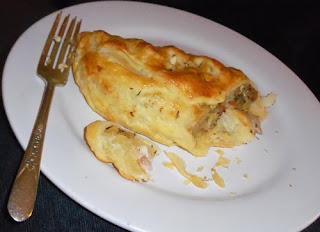
Instead of making a pie, why not make a slightly dryer filling and create these delicious chicken pasties. 
 
Chicken pasty

Roll out the puff pastry and cut into 6 - 8 inch diameter circles. I use a small plate. Spoon some of the filling onto one half of the circle, fold over the top and crimp the edges. Make a small hole to release the steam.

Paint a bit of beaten egg over the top.


Cooking any of these
 
Put the pie or pasties on a baking tray in a pre-heated oven.

Temperature gas mark 6/400F/200C/moderately hot.

Cook for 35 - 45 minutes, until the top is lightly browned and the filling is hot and bubbling.

Chicken Soup

I've already shared this recipe for Chicken, Leek, and Sweetcorn Soup

*These recipes will all work equally well with leftover turkey.*

Thursday, 28 November 2013

Chicken, Leek, and Sweetcorn Soup

Chicken, leek, and corn soup (with carrots)

One of my favourite soups this time of year is a chicken, leek, and sweetcorn soup.This particular recipe that I use is so easy that anyone can make it. I generally make a soup a day or two after cooking a roast chicken dinner.The chilli serves to lift the flavour without adding spicy heat. However, feel free to leave it out should you not want it.

Recipe

Main ingredients
You will need:
  • 4 cups Chicken stock
  • 1 - 2 cups cooked chicken meat
  • 2 leeks cleaned and chopped
  • 4 ears corn (Or 1 cup frozen corn)
  • 1 red jalapepeno chilli deseeded and diced
  • Optional: 1 x 400gm tin creamed corn 
  • salt and ground back pepper

Instructions
  1. Add all of the ingredients to the chicken stock. Bring up to a boil, decrease the heat and cover. Simmer gently for about 20 minutes. Season with salt and pepper to taste.
  2. Add other root vegetables if desired, just chop into bite size pieces first.
  3. Serve with crusty bread or rolls and butter.

Leeks

Leek
Leeks are a vegetable that grow partially in the ground, partially above ground. They are alliums and related to onions and garlic. The leek has a mild onion-y flavour and goes very well as a stand alone vegetable or combined with mild flavoured foods such as with chicken, pork or some types of fish.

The leek will need to be trimmed, cleaned, and sliced. Then slice the leek in half length-wise and cut each half into 1/4 - 1/2 inch wide strips.

How to clean a leek
The key to cleaning a leek is plenty of running water.

1. Peel off the outer leaves.
2. Trim off the darker part of the stalk. Save those for making a stock.
3. Trim off the root fringe and about 1/4 inch of the stalk.
4. Pull back the outer leaves enough to see where the dirt is hiding, hold the leek under running water, and rinse off as much as you can find.
I prefer not to cut the leek down lengthwise every time though this does make cleaning easier. In some dishes I want to cut the leek into rings, which is not really possible if I've sliced it in half already!.

Chicken

Chicken stock
Use a whole chicken or leftovers from a roast chicken dinner. Or do as I like to do and use reserved chicken carcasses plus the wings that have been kept in the freezer.
Place the chicken in a pot, add in the reserved leek stalks, a few black peppercorns, a bay leaf, some thyme, and a bit of salt.
Add in enough water to cover.
Place on the heat and bring up to a boil. Cover, decrease the heat, and let it simmer for at least 40 minutes. The longer you can leave it to cook, the better the stock will be and the more tender the chicken.
Once cooked, remove the chicken. Let the chicken cool and strip off all the meat.
Strain the liquid and return it to the pot.

Sweetcorn

sweetcorn
You can, of course, use frozen corn for this dish, but if corn is in season it's a good time to get a few fresh ears and trim the kernels off yourself.

Parboil the corn to start. Place the ears in a deep pot. Add in just enough water to cover and boil the ears for about 5 minutes. If you picked the ears yourself, they're probably quite fresh. If you bought them from the grocery store or supermarket though, there's a chance the ears are several days old, in which case the sugars will have started to break down.

Counter this and bring the sweetness of the corn out by adding a teaspoon of vinegar (cider vinegar works well) to the water.

Once cooked, remove from the water and cool. Then you can easily remove the kernels from the cob.

Do this using a sharp paring knife. Hold the ear at a 60 degree angle from the surface on a cutting board. Using a sawing motion, cut down each side of the cob to remove all the corn.

Strain and add the cooking water from the corn to the chicken stock if you want.


Saturday, 23 November 2013

Simple Fried Chicken


If you let it, cooking fried chicken can turn into a rather complicated affair, what with all the dredging and dipping. It doesn't have to be though. My simple recipe for fried chicken is easy to follow and delicious to eat.

The chicken

To start - if possible, buy a whole chicken. There are loads of tutorials online to show you how to cut a chicken up, or if you are fortunate enough to have a traditional butcher around, ask him to section your chicken for you and fillet out the breast if you don't want to cut it up yourself. Just be sure to tell him to bag up the carcass for you to make chicken stock.


A whole chicken will be way cheaper than buying a tray of chicken pieces and you'll be able to use the back to cook up a chicken stock for soup another day. If you don't want to make a stock that day, just pop the back pieces into a freezer bag and freeze them to be boiled up at a later date.

A whole chicken will give you 8 pieces of chicken - 2 legs, 2 thighs, 2 wings, 2 breasts - plus the back. I sometimes go further and cut the front wishbone part off the breast before I split the keel, giving me 9 pieces. And if I cut the breast off the bone I will pull away the narrow fillet piece from each breast and cook it those separately.

Chicken coating


I like to coat my chicken pieces is matzo meal, but can't always find it in the local grocery store. My second choice is bread crumbs, or for a gluten free option I use rice crumbles.

Whisk 2 medium eggs in a shallow dish, adding a pinch of salt and a pinch of ground black pepper.

You could dredge the chicken pieces in flour, then egg, then the breadcrumbs or matzo meal. I generally don't faff about all that much with it.

I dip it in the egg with one hand, then over it with the matzo meal/ breadcrumbs. I do my best to only touch dry ingredients with one hand and wet with the other but am generally not successful. Not to worry, those eggy - crumbly bits can be tossed in to cook along with the chicken and make for some crunchy treats (cook's privileges).

Choosing an oil/fat for cooking

My fat of choice to fry chicken is lard. Yeah, I know lard has gotten a bad rap in recent years. However, it is the best for frying up delicious chicken. It's my opinion that lard is a lot healthier for a person than any of the hydrogenated options that are out there.

If you don't want to use lard though, use a cold-pressed oil like sunflower oil. It needs to be about 1/2 inch deep in the skillet with at least another 2 inches clearance as the level will rise when you add the chicken.

Rapeseed, or canola oil is currently becoming quite popular, but it is another oil that I refuse to use. Too many fields are being converted over to growing rape, to the detriment of other native crops here in the UK, and to the utter misery of hayfever sufferers. Even people without hayfever suffer from this plant when its pollen gets into the air.

Cooking the chicken

Heat the lard, or oil, in a heavy-bottomed skillet over a moderate heat. Then carefully place the chicken in the pan in a single layer. Cover with a tight fitting lid and leave it for about 10 minutes. Check after 5 minutes to make sure it isn't browning too quickly, and reduce the heat if necessary.

fried chicken
Chicken frying in SKK saute pan
Once browned on one side, using a pair of tongs carefully turn each piece over, put the lid back and cook another 10 minutes.

With practice you will get to know when the chicken is cooked by feel - give one of the fleshier pieces like the breast a squeeze with the tongs. When it is as firm as the end of your nose, it's cooked. Until you get to know what this feels like fully, go ahead and check for doneness by pulling a piece out and cutting into it with a knife.


 Place a double or triple thickness layer of kitchen paper in a serving dish and transfer the chicken to that once it has cooked. If you're going to make a chicken gravy, put the dish into a warm oven to keep hot until you're ready to serve it.

This chicken is just as nice eaten cold.