Showing posts with label onions. Show all posts

Monday, 9 November 2015

Slow-Cooked Beef Stew

I love the flavour of slow cooked beef, and I love eating stews this time of year when it starts getting cooler. But I hate overcooked, mushy vegetables. This recipe takes a bit more work in the kitchen, but in the end gives me the best of both, tender, fall apart beef and cubed root veggies which still have their shape and texture.
slow-cooked beef stew

You will need:
  • 2 pounds beef - I get a mixture of oxtail and stewing beef or skirt cut into cubes. 
  • 1 onion, quartered
  • 2 cloves garlic, crushed
  • 2 bay leaves
  • 2 cups water
  • salt and pepper

  • 2 large potatoes, peeled and chopped
  • 1 small, or 1/2 large swede, peeled and chopped
  • 2 large carrots, peeled and chopped
  • 2 parsnips, peeled and chopped
  • 1 cup fresh or frozen peas
  • any other veggies you want to add
  • water
  • Worcestershire sauce
    Assorted veg and herbs for an Autumn stew

  • 2 tablespoons corn flour/corn starch
  • 1 tablespoon cool water

1. Place the beef into a slow-cooker along with the onion, garlic, bay leaves, and water. Set on low and leave to cook for at least 6 hours, but let it go for as long as you can. I will usually put it all in the pot the night before and leave it to slow cook overnight and through the day. Otherwise, put it all in the pot in the morning and let it cook through the day.

2. About 45 minutes before you're ready to eat, remove the beef from the slow cooker to a tray and strain the stock into a large pot. Add in all the chopped vegetables, topping with water if needed. Bring to a boil, reduce heat and simmer about 15 - 20 minutes or until the vegetables are all cooked.
Taste for seasoning and adjust as needed. Add a splash of Worcestershire sauce. 

3. Make a thin paste using the corn flour and water and add to the pot, stir until it begins to thicken. Remove the ox-tail bones from the meat, shred, and add it all to the pot.

4. Let simmer a few more minutes until it is all piping hot.

Serve in a bowl with thick slices of bread.

Alternately, leave the potatoes out of the mix of root vegetables and make a separate pan of mashed potatoes. Serve the stew over the mash.


 The beef: I like using cheaper cuts of beef as they will be cooked for a long while. Skirt steak has very long muscle fibres that can become very, very tough if not cooked properly. Make sure to cut against the grain of the muscle when cubing. It should be either slow-cooked for several hours, or cut into strips against the grain and flash fried for a few seconds.

Ox tail provides a depth and richness to a stew. It can be quite fatty, and that can overwhelm a dish, which is why I use a combination of both skirt/stewing steak and ox-tail.

My son who does not eat stews, gravies, or any root veg besides carrots and potatoes gets a deconstructed stew with a serving of beef, a serving of mashed potatoes, some of the cooked carrots and peas.


Thursday, 19 December 2013

Bangers, Mash, and Onion Gravy

Sausage and onion gravy (creative commons)
There is little that could be more British than a meal of Bangers and Mash.  These are good on their own, or with a chutney, but when it comes to accompaniments that make this dish even better, you just can't beat a ladle full of a caramelised onion gravy.


To make this gravy, you need to take a bit of time, at least an hour just to cook the onions down to a caramelised golden brown. Oh, you'll find recipes that claim you can make this gravy in less than 20 minutes. These are the same recipes that tell you to add a large spoonful of sugar to the onions. For absolute depth of flavour that brings out the natural colouring and sweetness of the onions, forget the sugar and spend that extra bit of time cooking.

Sausages are a British tradition

The Brits didn't invent the sausage, but I don't think you will find a nation who loves them more than the British do.

Some interesting Sausage Facts

  • The Sumerians were making sausages 5,000 years ago

  • In 320 A.D. the Catholic Church banned the eating of sausages due to their association with Pagan festivities

  • Sausages were first divided into links in Britain during the reign of Charles I (1600-1649)

  • 'Bangers' which is the British nickname for sausages, originated from the Second World War when the high water content made them tend to explode during cooking as the water turned to steam

  • Sausage machines can fill sausages at a rate of 1 ½ miles an hour

  • There are over 400 different varieties of sausages in the UK

  • The most expensive sausage in the UK was made from fillet steak with Champagne and truffles and cost £20 each!

According to the Agriculture and Horticulture Development Board Meat Services:

  • 88% of British households have bought sausages

  • 50% buy sausages at least every four weeks

  • Every day, five million Britons will eat sausages

  • 46% of the total amount of pork sausages consumed are eaten in the evening.
British sausages (creative common)


Caramelised Onion Gravy Recipe

You will need:

3 - 4 large onions; use 1 - 2 red or sweet onions. I like to use 2 Spanish onions and 2 red onions - thinly sliced in rings
75 gm butter
400ml chicken or beef stock
100ml red wine - you could use 100ml of ale/bitter or Madeira instead, or substitute another 100ml stock
1 tsp Worcestershire sauce
2 tsp French mustard - English mustard would be too hot
Salt and pepper to taste

Cooking method:

Melt the butter in a heavy pan
Cook the onions over a medium heat for about 20 minutes, stirring frequently, until they are soft. You aren't frying them here. You're softening them down.
Decrease the heat to low.
Leave the pan uncovered and cook the onions down slowly until they are browned. This will take at least 1 hour, possibly longer. There is no rush. The slower the onions cook, the more their natural sugars will be released providing the golden brown caramelized colouring and flavour you are looking for. Go back in the kitchen and give them a stir round occasionally, but otherwise just leave them alone to cook.
When the onions are nicely cooked, add in the remaining ingredients. Increase the heat and bring it up to a simmer. Check the seasoning, and serve over a plate of mashed potatoes with sausages.

Cooking sausages

Lincolnshire Sausages
Pick a good sausage for this meal. I'm not talking about breakfast sausage links here. I'm referring to any of the varieties of traditional British sausages. In our house, we like Lincolnshire sausages though just about any will be enjoyed.

These sausages can be fried in a pan, cooked under a grill, or cooked in a moderately-hot oven. My preferred method is to grill them.

I place the sausages in 2 rows on the grill pan and place it under a moderate heat. This allows the sausages to brown nicely on each side as they are turned, and cook inside. Cooking time about 20 minutes.


You can find Lincolnshire sausages in any grocery store and most butchers. For a good authentic Lincolnshire sausage, I recommend buying them directly from Mountain's Boston Sausage Company. I've bought sausages and other meat products from this family run company in Boston, Lincolnshire before and highly recommend them.

Not in the UK? Check with your local traditional butcher. They just might be able to help you. Or, you could try making your own sausages at home.

Once you've gor your bangers and your onion gravy, you just need to cook up a big pile of creamy mashed potatoes, and your meal is sorted.

Monday, 9 December 2013

Sausage and Potato Pie

This is one of those recipes I picked up several years ago when I was looking for different ways to cook savoy cabbage. Of course, I modified it my own use. This is a delicious and filling meal on its own or if you want you could always serve this with some carrots or peas on the side.

It is a nice warming meal for cold days come Autumn and Winter time.

Sausage and Potato Pie


Serves: 4 | Prep Time: Total Time:

Ingredients

  • 8 Cumberland sausage links, or 1 Cumberland sausage coil
    Bottom layer of potatoes
  • 115 gram butter
  • 2 large onions finely sliced
  • 175 gram bacon lardons
  • 1 head savoy cabbage finely shredded
  • 1 kg floury potatoes parboiled and thinly sliced
  • 2 tbsp fresh thyme leaves
  • 570 ml double cream
  • 425 ml fresh beef stock
  • 2 bay leaves
  • salt & pepper to taste

Instructions


  1. Preheat oven to 170C/325F/Gas 3.
  2. Heat a sauté pan. Add the sausages and gently fry until they are about three quarters cooked and
    Cooking bacon lardons
    golden brown. Remove from the pan and slice. Parboil the potatoes then thinly slice.
  3. Add 55g/2oz of the butter to the sauté pan and once melted add the onions. Cook the onions gently for 10 minutes or until soft and translucent. Remove from the pan and set aside.
  4. Add the bacon lardons to the frying pan and cook for 3-4 minutes until golden and crispy. Add the cabbage with 2 tablespoons of water. Cook for 2-3 minutes or until the cabbage is soft, but still holding a little texture. Drain off any fat, remove from the pan and set aside.
  5. Rub a large gratin dish (30x21x6cms/12x8x2in) liberally with 25g/1oz butter.
  6. Place a layer of sliced potatoes in the bottom of the dish season with salt and pepper and a sprinkling of the thyme.
  7. Top with a layer of sliced sausage, then a layer of cooked onion.
  8. Top with another layer of sliced potato and season with salt, pepper and thyme.
    Layering ingredients into a dish
  9. Spoon over the cooked cabbage and bacon.
  10. Top with another layer of potato slices and season again with salt, pepper and thyme.
  11. Top with a layer of sliced sausage, then a layer of cooked onion and finally a layer of sliced potato.
  12. Season once again with salt, pepper and thyme.
  13. Pour the cream and stock into a pan and add the bay leaves. Place over a gently heat and bring to just below boiling point. Pour over the sausage and potato pie. You want the liquid to just cover the top layer of potatoes. Dot over the remaining butter and cover with foil. Place the dish on a baking sheet. Place in the oven and cook for 1.5 hours.
  14. Remove the foil from the dish and increase the oven temperature to 200C/400F/Gas 6 and cook for a further 15 minutes or until the top is golden. Serve immediately.

The sausage, onions, bacon, and cabbage were all cooked in my SKK Saute Pan. You can find it in the SKK Amazon store linked to at the bottom of this page.  

Monday, 25 November 2013

How to Chop an Onion

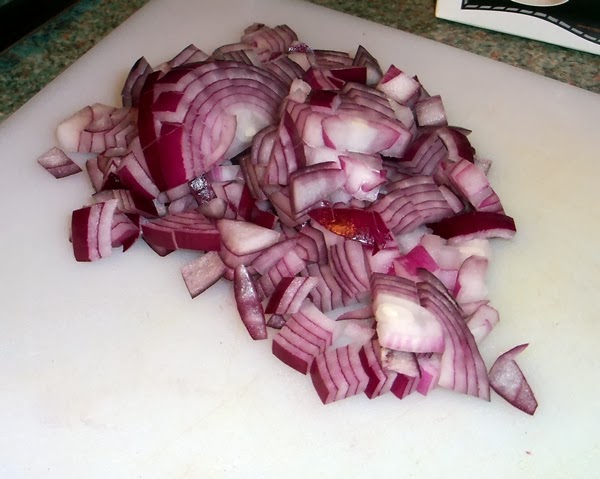
Chopped red onion
If your kitchen is anything like mine, a good deal of time with cooking each day is taken up with chopping onions. Nearly every recipe has at least one sliced, diced, or chopped onion in it. This is why knowing how to chop an onion safely and quickly is a very good skill for even the casual home cook to have.

It starts with a sharp knife

I cannot emphasise enough how important having a sharp knife is when you're chopping an onion. Do you ever wonder how it is that chefs can chop onions so quickly? It is because that knife is extremely sharp!

These days, I chop onion, peppers, and most other vegetables using a ceramic knife. These hold an edge better than any other knife I have found, and are easy to care for and maintain.


Step-by-step instructions for chopping an onion

1. Top and tail the onion, then cut it in half through the stem.


2. Remove the papery outer covering


3. Make 2 - 3, or more horizontal cuts through the onion half, leaving the stem intact. The number of horizontal cuts you make will help determine how large the chopped pieces will be


4. Make several vertical cuts through the onion, leaving the stem intact. Make these cuts between 1/2 and 1/8 inch thick depending on how large you want the onion pieces to be. The natural striations on the onion are a useful guide for cutting.


5. Slice through the onion, starting at the head and working down to the stem. This last bit can be thrown into the compost or tossed into a pot with other end bits to make a stock.


And there you have it, one onion completely chopped. And once you've gotten a bit of practice in, you'll be able to do your chopping in less time than it took to read this how-to guide.

Happy cooking!